Ice Hockey Rules, Scoring & Competition Format — A Complete Guide
The basics
Goals count as one point each. Three periods of 20 minutes. Penalties send players off the ice for 2 or 5 minutes, giving the other team a power play. Overtime is sudden death — first goal wins.
Puck, Power Plays, and Periods: How Ice Hockey Rules Work at the Olympics
Ice hockey at the Winter Olympics operates under International Ice Hockey Federation (IIHF) rules, which differ from the NHL in several important ways. The rink is bigger, the penalties are stricter, and the tournament format creates a win-or-go-home intensity that even the Stanley Cup Finals can’t quite match.
IIHF vs. NHL Rink
Olympic hockey is played on an international-size rink: 60 meters long and 30 meters wide (approximately 200 × 98 feet). This is significantly wider than an NHL rink (200 × 85 feet). The extra 13 feet of width opens up the game, rewards speed and passing, and makes it harder for one defenseman to cover the zone. European-trained players who grew up on bigger ice often thrive.
Game Structure
An Olympic hockey game consists of three 20-minute periods of stop-time play (the clock stops whenever the whistle blows). Between periods, the ice is resurfaced. If the score is tied after regulation:
- Preliminary round: a five-minute 3-on-3 overtime period is played. If still tied, a shootout (best of five, then sudden death) decides the game.
- Elimination round (quarterfinals onward): overtime is a full 20-minute, 5-on-5 sudden-death period. Additional 20-minute OT periods continue until someone scores. There is no shootout in elimination games.
This means a gold medal game could theoretically last for hours — unlike the NHL playoffs, which use the same format but with more stoppages.
Penalties
IIHF penalty rules are largely similar to the NHL with some key differences:
- Minor penalty (2 minutes): tripping, hooking, slashing, interference, etc. The offending player sits in the penalty box; their team plays shorthanded (typically 4 vs. 5).
- Major penalty (5 minutes): fighting (automatic), severe hits, or any penalty causing injury. Under IIHF rules, a major penalty also triggers a game misconduct — the player is ejected for the rest of the game.
- Misconduct (10 minutes): the player is removed for 10 minutes, but the team does not play shorthanded — a substitute serves the penalty time.
- Game misconduct: ejection from the current game.
- Match penalty: ejection plus automatic suspension from the next game (or more, pending review).
Critically, fighting in IIHF hockey results in an automatic major penalty and game misconduct for both participants. The NHL’s tolerance for fighting does not exist at the Olympics.
Power Plays and Penalty Situations
When a team is penalized, the opposing team goes on a power play. If the power-play team scores, the minor penalty ends immediately (the penalized player is released). Major penalties, however, do not end early — the offending team stays shorthanded for the full five minutes regardless of goals scored.
A team can be down two players simultaneously (3 vs. 5), but never fewer than three skaters. If a third penalty is called, it is served sequentially once one of the first two expires.
Olympic Tournament Format
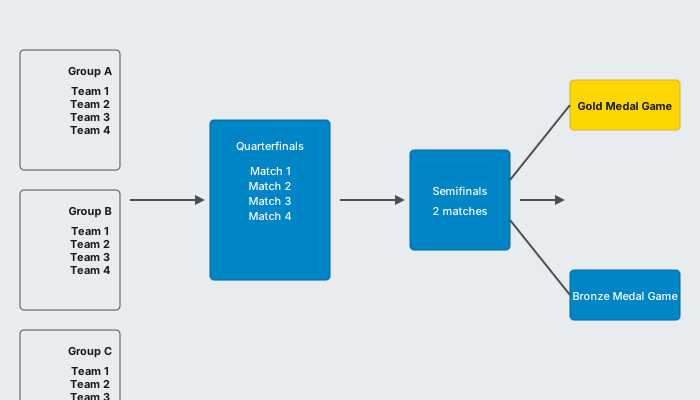
The 12-team Olympic hockey tournament (for both men’s and women’s) typically uses:
- Group stage: three groups of four teams play round-robin. Points are awarded: 3 for a regulation win, 2 for an overtime/shootout win, 1 for an overtime/shootout loss, 0 for a regulation loss.
- Qualification round: lower-finishing group teams play a single-elimination game.
- Quarterfinals, semifinals, finals: single elimination.
The host nation receives an automatic berth. Other teams qualify through IIHF world rankings and qualification tournaments. At Beijing 2022, Finland won men’s gold with a 2-1 victory over ROC in the final.
Icing and Offside
IIHF uses hybrid icing: if the puck is shot from behind the center red line past the opposing goal line without being touched, the linesperson judges whether the defending player or attacking player would reach the puck first. If the defender would win the race, icing is called. The faceoff comes back to the offending team’s defensive zone, and that team cannot make line changes.
Offside works as in the NHL: an attacking player cannot enter the offensive zone ahead of the puck.