Figure Skating Rules, Scoring & Competition Format — A Complete Guide
The basics
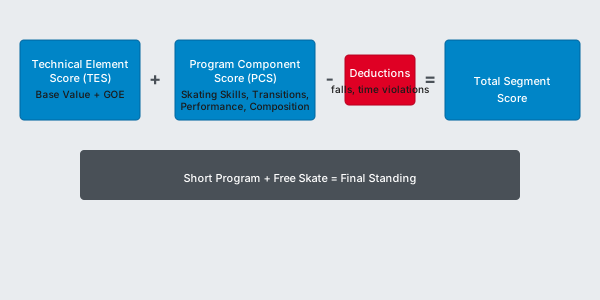
Each skater receives a Technical Element Score (TES) based on jumps, spins, and steps, plus a Program Component Score (PCS) for skating skills, transitions, performance, and composition. The two scores combine for the total. Higher is better.
Blades and Artistry: How Figure Skating Is Scored at the Winter Olympics
Figure skating is the Winter Olympics’ most-watched sport, a rare competition where artistic interpretation carries the same weight as athletic prowess. But behind the music and the costumes lies a meticulously detailed scoring system maintained by the International Skating Union (ISU) — one that was completely overhauled after the 2002 Salt Lake City judging scandal and has evolved continuously since.
Olympic Events
The Winter Games feature five figure skating events:
- Men’s singles — short program and free skate.
- Women’s singles — short program and free skate.
- Pairs — short program and free skate.
- Ice dance — rhythm dance and free dance.
- Team event — nations field entries across all four disciplines, accumulating points toward a team total.
The ISU Judging System (IJS)
Replacing the old 6.0 system after 2002, the ISU Judging System (sometimes called the Code of Points) breaks every performance into two scores:
-
Technical Element Score (TES): Each element (jump, spin, step sequence, lift) has a base value set by the ISU. Judges then assign a Grade of Execution (GOE) — essentially a quality bonus or penalty — ranging from -5 to +5. Each GOE step has a point value that’s proportional to the element’s base value. A quad Lutz has a base value of 11.50 points; a GOE of +3 might add roughly 5 points, while a fall (GOE -5) deducts about 5.75 points.
-
Program Component Score (PCS): Five categories — Skating Skills, Transitions, Performance, Composition, and Interpretation of the Music — each scored on a scale of 0.25 to 10.00 by the panel. The five component marks are multiplied by a factor that varies by event segment (e.g., the men’s free skate uses a factor of 2.0, so a perfect 10 in one component yields 20 points).
The total score = TES + PCS - Deductions.
Jumps: The Crown Jewels
Six types of jumps exist, distinguished by takeoff edge and toe assist:
- Toe loop, Flip, Lutz — toe-assisted jumps (the skater picks into the ice with the toe pick).
- Salchow, Loop, Axel — edge jumps (no toe pick assist).
The Axel is the only jump that takes off going forward, requiring an extra half rotation. A triple Axel is 3.5 rotations; a quad Axel — first landed in competition by Ilia Malinin in 2022 — is 4.5 rotations.
Jump base values increase with rotations: a triple Lutz is worth 5.90 points, while a quad Lutz is 11.50. When Nathan Chen scored 332.60 to win gold at Beijing 2022, his five quad jumps in the free skate were the engine of that score.
Under-Rotation and Downgrades
The technical panel (separate from the judges) reviews each jump using instant replay:
- Fully rotated: full base value.
- Under-rotated (q): missing less than ¼ rotation — GOE is reduced.
- Under-rotated (<): missing ¼ to ½ rotation — base value reduced by approximately 20%.
- Downgraded («): missing more than ½ rotation — the jump is scored as one rotation lower (e.g., a downgraded quad becomes a triple).
Deductions
Falls incur a mandatory -1 point deduction per fall (applied separately from GOE). Other deductions include time violations (program too long or too short), illegal elements, costume malfunctions (pieces falling on the ice), and late starts.
Short Program vs. Free Skate
The short program has required elements: for men’s singles, this includes a double or triple Axel, a quad or triple jump, a combination of two jumps, three spins, and a step sequence. The free skate allows more jumps (up to seven for men, including combinations) and more creative freedom. Both scores are added together for the final result.
Ice Dance vs. Pairs
Though both feature two skaters, the disciplines are fundamentally different. Pairs include throws, side-by-side jumps, and overhead lifts. Ice dance prohibits jumps of more than one revolution, lifts above the shoulder, and throw jumps — emphasizing footwork, musicality, and skating in hold. The rhythm dance has a prescribed theme (e.g., street dance, waltz) that changes each season.