Curling Rules, Scoring & Competition Format — A Complete Guide
The basics
Each end (round), the team with the stone closest to the center scores one point for each of their stones closer than the opponent's best. Games are 8 ends (mixed doubles) or 10 ends. Highest total wins.
Stones, Strategy, and the Sheet: How Curling Rules Work at the Olympics
Often called “chess on ice,” curling rewards strategic thinking as much as physical execution. It’s one of the few Olympic sports where yelling at your teammates is not only acceptable but essential — those sweeping calls of “Hard! Hard!” and “Whoa!” are how the skip directs the stone’s path. The World Curling Federation (WCF) sets the rules for a game that looks deceptively simple but contains remarkable tactical depth.
Olympic Events
Curling at the Winter Olympics features three events:
- Men’s tournament — teams of four plus an alternate.
- Women’s tournament — teams of four plus an alternate.
- Mixed doubles — introduced at PyeongChang 2018, featuring one man and one woman per team, with modified rules.
Basic Structure: The End
A standard curling game consists of 10 ends (like innings in baseball). In each end, the two teams alternate throwing (delivering) stones toward the target (the house). Each team throws eight stones per end — each of the four players delivers two stones. In mixed doubles, each player throws five stones, with one pre-placed stone for each team.
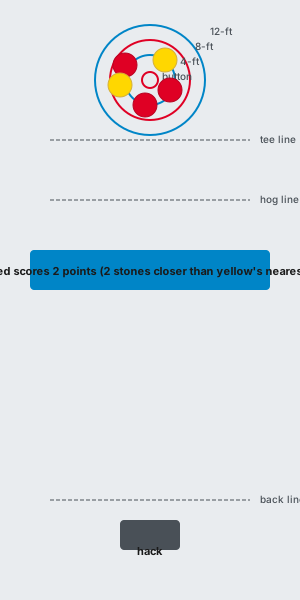
After all 16 stones are thrown in an end, the team with the stone closest to the center of the house (the button) scores. That team receives one point for each of their stones that is closer to the button than the opponent’s closest stone. Only one team can score in a given end.
The Sheet and the House
The playing surface — the sheet — is approximately 45 meters long and 5 meters wide. The house consists of four concentric rings with the button at the center. The rings are for visual reference only; what matters is the actual distance from the button, measured precisely when needed.
The hog line is crucial: a stone must be released before the near hog line and must cross the far hog line to remain in play. Stones that don’t reach the far hog line are removed. The back line is the boundary at the far end — stones that completely cross it are also removed.
Sweeping
After a stone is released, two teammates may sweep the ice in front of it. Sweeping warms the ice surface, reducing friction and allowing the stone to travel farther and curl (curve) less. Once a stone crosses the tee line at the far end, only one player from each team may sweep it (the defending skip can sweep once it passes the tee line).
The WCF bans certain sweeping techniques, including directional sweeping intended to steer the stone sideways. The “broom-gate” controversy of 2015 led to strict equipment regulations on brush heads.
The Hammer and Strategy
The team that throws last in an end has the hammer — a significant strategic advantage, since the last stone can knock opponents out or sneak into scoring position. The team that scores in an end gives up the hammer for the next end. A blank end (no points scored) allows the team with the hammer to keep it — teams will sometimes deliberately blank an end to retain last-stone advantage.
Scoring one point with the hammer is considered a poor result; ideally, the team with the hammer scores two or more. At Beijing 2022, Sweden’s men’s team (led by Niklas Edin) won gold by consistently leveraging multi-point hammer ends.
Timing and the Thinking Clock
Each team gets a set amount of thinking time per game — typically 38 minutes for a 10-end game under WCF rules. The clock runs only when it’s your team’s turn to make a decision (not during delivery or sweeping). Running out of thinking time forfeits the game.
Mixed doubles uses a shorter clock (22 minutes), contributing to a faster-paced format.
Concession and Extra Ends
Teams can concede at any point if they feel the deficit is insurmountable — this is common in curling and considered good sportsmanship, not quitting. If the score is tied after 10 ends, extra ends are played until there’s a winner. In the extra end, the hammer goes to the team that didn’t score last.
Free Guard Zone Rule
The free guard zone (FGZ) rule transformed curling strategy. During the first five stones of each end (the first four thrown stones in four-player, first three in mixed doubles), any opponent’s stone in the free guard zone (the area between the hog line and the house, excluding stones in the house) cannot be removed. If a team knocks a guard out of play during this period, the guard is replaced and the thrown stone is removed. This rule encourages offensive play and prevents teams from simply blasting all stones away.